
Campaign reports
After sending a campaign, Flexmail automatically generates a detailed report. This article explains what you'll find in the campaign reporting dashboard, how to navigate an individual campaign report, and how to read your results in a way that helps you improve over time.
Prerequisites
- You have sent at least one campaign.
- Test campaigns and archived campaigns don't appear in the reporting dashboard table, check for those in Manage campaigns instead.
The campaign reporting dashboard
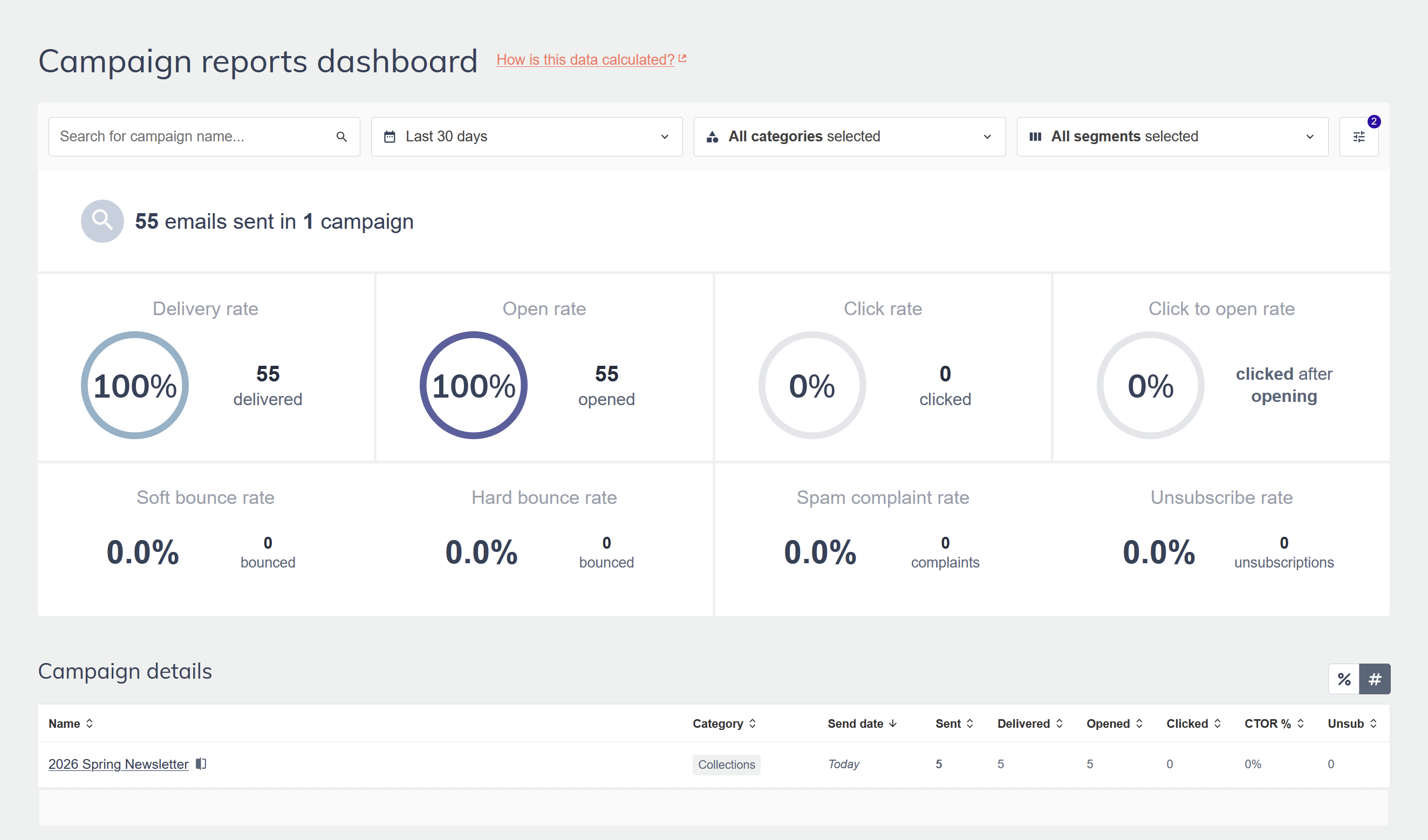
Go to Campaigns, then Campaign reports, to open the dashboard. By default, it shows all campaigns from the past 30 days.
Key metrics
Eight performance indicators are shown at the top of the dashboard: delivery rate, open rate, click rate, click-to-open ratio (CTOR), soft bounce percentage, hard bounce percentage, spam complaints percentage, and unsubscribe percentage. Metrics that need attention are visually flagged. A spam complaint rate above 0.1% or an unsubscribe rate above 1.5% appears in red.
The campaign table
Below the KPIs, a table lists each campaign with its key performance data. Click any campaign name to open its full report. Toggle between percentages and absolute numbers using the icon in the top right, and sort by any column by clicking the header.
Filtering the dashboard
Adjust the time period using the period selector at the top, or use the filter options to narrow results by category, segment, or campaign type. Active filters appear at the top of the dashboard and can be removed individually. Use the search bar to find a specific campaign by name.
Attention Archived campaigns and test campaigns don't appear in the dashboard table.
The individual campaign report
Click any campaign name in the dashboard to open its full report.
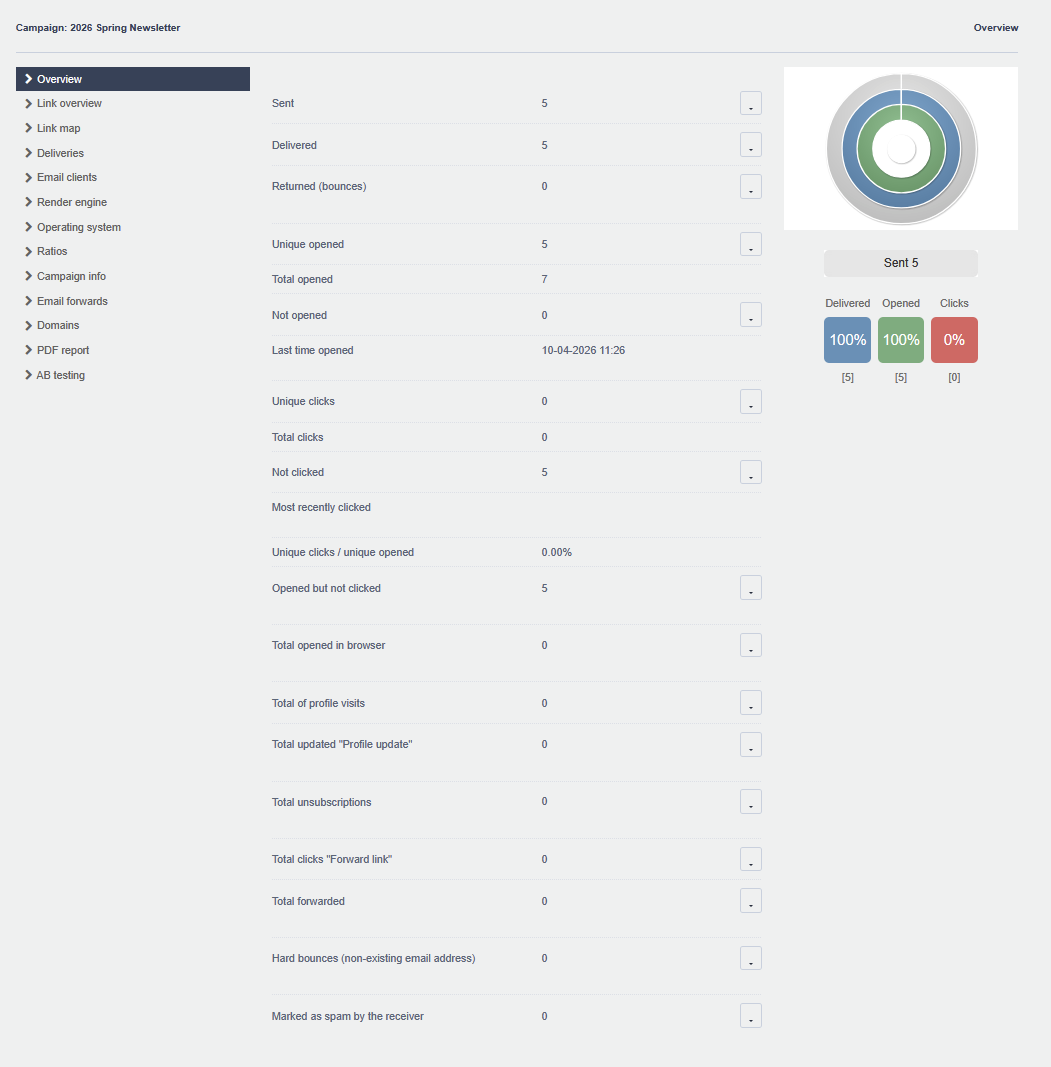
Overview
Delivery, open, and click statistics. Click the arrow next to any metric to see more detail, export the data, or start a new campaign from the same recipients.
Link overview
Every tracked link in your campaign, with the number of clicks per link. Click the gear icon next to a link to see which specific contacts clicked it.
Link map
A visual preview of your message with click percentages overlaid on each link. Useful for seeing at a glance which parts of your email drove the most engagement.
Deliveries
Bounced emails broken down by bounce type and bounce code, with explanations for each code. You can export this data for further analysis.
Email clients and operating systems
Shows which email clients and devices your contacts used to read the campaign. Use this to prioritise which clients to test your templates in.
Ratios
Compares your open rate, bounce rate, and click-through rate against the average across all campaigns in your account. Useful for understanding whether a specific campaign performed above or below your usual baseline.
AB testing
If you ran an AB test, the results appear here, performance of each variant and which one was declared the winner.
PDF reporting
Generate and download a PDF summary of the campaign. Configure which data is included in PDF reports under Settings > PDF reporting.
How to read your results
Open rate
Your open rate reflects the effectiveness of your subject line and sender name, the two things contacts see before deciding whether to open. Compare it to your account average in the Ratios section. Keep in mind that open tracking relies on a tiny tracking pixel that only fires when a recipient loads images. Contacts who read your email with images disabled won't show as opens, even if they read every word.
Click rate and CTOR
Click rate tells you how many of your delivered emails led to at least one click. CTOR removes the influence of subject line performance and tells you how compelling your content was for the people who actually opened. A high open rate with a low CTOR means the subject line was compelling but the content didn't follow through. A low open rate with a high CTOR means the content is strong, work on getting more people to open first.
Bounces
Hard bounces (codes starting with 5) indicate permanent failures, the address doesn't exist or has been permanently blocked. Flexmail automatically blacklists addresses that return a 5.1.1 code. For other hard bounce codes, three consecutive bounces trigger blacklisting. Soft bounces (codes starting with 4) are temporary, full inbox, server temporarily unreachable. These are retried automatically.
Spam complaints
A complaint is recorded when a contact clicks "This is spam" in their email client. Flexmail blacklists that address and it cannot be reactivated without contacting support.
Support tip Look for outliers between campaigns rather than absolute numbers. If one campaign's unsubscribe rate is three times higher than usual, something about it, frequency, content, targeting, was off. That's far more useful information than the absolute percentage.
Common mistakes to avoid
- Comparing open rates across very different campaign types. A newsletter and a promotional flash sale will have different open rates by nature. Compare like with like.
- Treating open rate as the primary success metric. Open tracking is imprecise (image blocking affects it). Click rate and CTOR are more reliable indicators of actual engagement.
- Not acting on high bounce or complaint rates. A hard bounce rate climbing over several campaigns signals a list quality issue. A spam complaint rate above 0.1% affects inbox placement for your entire account.
- Ignoring the email clients report. If 60% of your contacts read on mobile and your template isn't mobile-optimised, your click rate will suffer. This report tells you where to focus your template testing.
GDPR considerations
GDPR A spam complaint rate above 0.1% can affect inbox placement for your entire account. High complaint rates usually indicate a consent issue, contacts who didn't expect your emails or no longer consider them relevant. If your complaint rate is elevated, review your consent practices, the relevance of your content, and the accuracy of your segmentation before sending the next campaign.
Next steps
- After reviewing your report, use the "Start a new campaign from these recipients" option to follow up with contacts who clicked or didn't open.
- Export your bounce data and clean up hard bounces from your account.
- Use the email clients report to decide which clients to prioritise in your next template test.
- If you ran an AB test, note the winning variant and apply the learnings to your next campaign.