
Create a landing page
Landing pages are web pages you build inside Flexmail to extend the content of your emails. Instead of cramming all your information into a message, you keep the email light and link to a landing page for anyone who wants to know more.
A typical use: a newsletter mentions three products with a short description of each, and a "Read more" link for each that leads to a dedicated landing page with the full details. The email stays scannable; the landing page provides depth for interested readers.
How to share a landing page
- As a link inside a Flexmail campaign: when a contact clicks through, you can track who visited, assign an interest based on the click, and link their visit to their contact record.
- As a public web link: Flexmail generates a hosted URL for every landing page. You can share this on your website or social media.
Attention Personalisation in landing pages only works when the contact arrives through a tracked link in a Flexmail campaign. Public web links have no contact context, personalisation placeholders will appear empty.
Create a landing page
-
Go to Landing pages in your account.

-
Click Create new landing page.
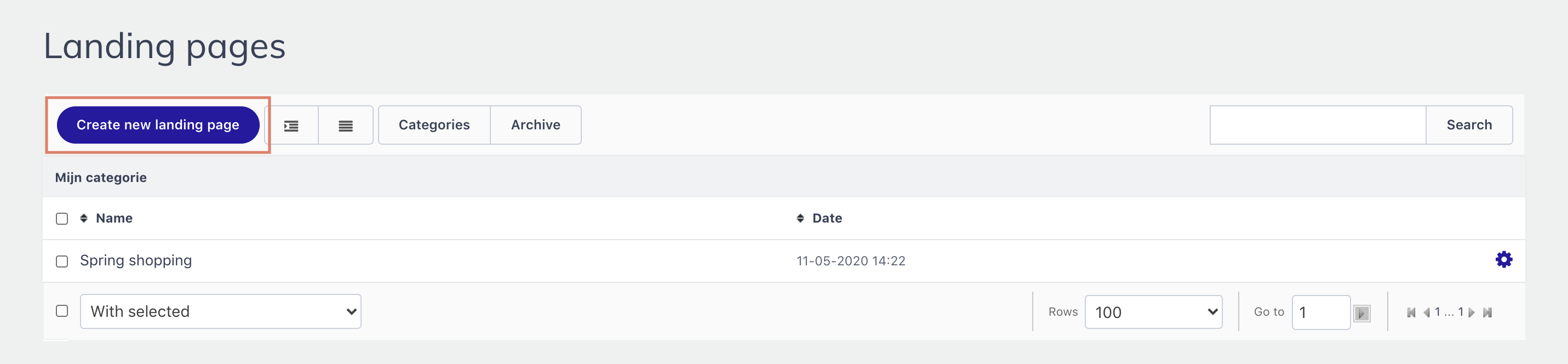
- Choose your editor: Drag & Drop builder or HTML Editor.
- If using the Drag & Drop builder, optionally choose a template.
- Enter a name, select a category, and click Save.

Support tip Name your landing pages clearly and consistently, something like "Product A, autumn 2025" rather than "Landing page 3". When you're reviewing link tracking data weeks later, clear names make it much easier to interpret results.
Build your landing page
Building a landing page works similarly to building an email message. The retired drag & drop builder is still available for landing pages, while for messages it has been replaced by the Email Builder. These two builders work in a similar way, with comparable tools, elements, and personalisation options. The HTML editor is also available for both messages and landing pages, and works the same way as when creating a message.
A few things specific to landing pages:
- You can include links to forms or surveys on a landing page, use the form or survey link type inside your landing page content.
- You can use link tracking on links within your landing page to track clicks and assign interests.
- You can use personalisation placeholders, but only when contacts arrive via a campaign link, not via the public web URL.
Link a landing page to your message
To add a landing page link to an email, use the Landing page link type when adding a link in your message. See 'Link to forms, surveys and landing pages' in the Messages section for
step-by-step instructions for all three editors.
Use link tracking with landing pages
You can assign an interest to a landing page link in your message. Any contact who clicks through to the landing page is automatically subscribed to that interest. This is one of the most effective ways to build audience data based on actual content interest,contacts who click through to your product page have shown more intent than those who simply opened the email.
Pro tips
- Keep each landing page focused on one topic. If your email mentions three products, each product should have its own dedicated landing page.
- Match the visual style of your landing page to the email it came from, same colours, fonts, and tone. A jarring disconnect between the email and the landing page undermines trust.
- Put your primary call to action above the fold. Most visitors decide within 30 seconds whether to stay or leave.
- Use clear, action-oriented button text. "Download the guide" is more compelling than "Submit". "Register now, free" is clearer than "Click here".
Next steps
- See 'Link to forms, surveys and landing pages' to add a landing page link to a campaign.
- See 'Landing page best practices' for content and conversion guidance.
- See 'Use interests' to understand how interest assignment via link tracking works.